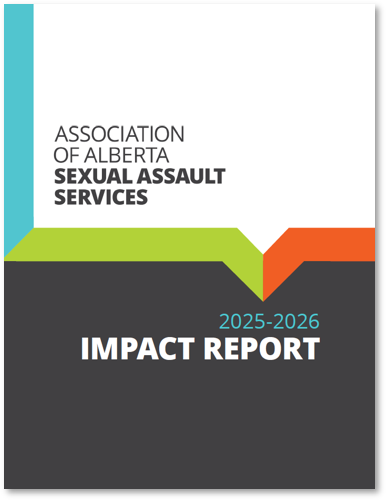
On September 18, the Association of Alberta Sexual Assault Services (AASAS) released its 2025–2026 Impact Report. Drawn from fifteen member sexual assault services, it tells a province-wide story of the impact of specialized sexual assault services across Alberta over the past year.
Behind every figure is a person: a tentative first call, a first counselling session, a question about what to do next, a classroom where someone finally has words for what happened to them. Across Alberta, sexual assault services are there for those moments, while also working in schools, workplaces and communities to change the conditions that allow sexual violence to happen in the first place.
When we look back on the year, the clearest signal is this: people continued to reach for specialized sexual violence services, sometimes for immediate support, and sometimes for care that continued over weeks, months, or different points in their lives.
They called. They texted. They walked in. They connected with someone who understood the shame, self-blame, and disruption that follow this particular harm. Across Alberta, staff responded to 9,696 contacts for immediate support and 5,368 people accessed specialized counselling.
Access to that care is improving, too. Since 2023–2024, average counselling wait times have fallen by 46%, from more than 26 weeks to under 14.
And that support made a measurable difference. Among adult individual counselling clients, 82% showed reductions in trauma symptoms, 94% demonstrated progress toward their goals, and 95% felt respected, listened to and taken seriously. Among children and youth receiving specialized therapeutic support, 71% demonstrated measurable reductions in trauma symptoms.
Sexual assault services exist for all of these moments, from the first time someone reaches out to the ongoing support they may choose along the way.
A common misconception is that sexual assault services are all about counselling. Specialized counselling is a vital part of the work. However, it is only one part of the specialized continuum of care.
There is no single path. People reach out at different times, for different reasons, and with different needs. Someone might want to talk about what happened, ask a question, understand their options, or figure out what support is available. They may need help finding housing or income support, specialized assistance while navigating a police investigation or court process, or, in some communities, someone beside them while accessing medical care.
Last year, 2,803 people accessed systems navigation services, 1,287 new and continuing clients received specialized police and court support, and staff provided 360 hospital accompaniments.
Specialized sexual assault services meet people where they are, offering the support and information they need at different points in their journey.
Access to specialized support isn’t only about where a sexual assault service is located. It is about making support visible, reachable, and connected to the places and people where Albertans already live, learn, work, and seek help.
Across the province, sexual assault services are doing that in many ways: through satellite locations and virtual services, community outreach, and partnerships with communities, schools and post-secondary institutions, health and justice services, and other community organizations.
And that reach is growing. This year, virtual connections grew from 4,024 to 6,157 people, while satellite visits nearly doubled from 896 to 1,722. Altogether, sexual assault services reached 164 communities across Alberta.
That outreach does more than bring services closer to home. It builds relationships, increases awareness, strengthens how communities respond to sexual violence, and creates clearer pathways to specialized support. So when someone is ready to reach out, they are more likely to find the right help at the right time.
Support does not begin at the door of a sexual assault service. It begins earlier: in a family, a classroom, a workplace, a community hall. Prevention is how communities become places where harm is less likely, and where, if it happens, people are believed, supported, and know where to turn.
Last year, sexual assault services delivered 3,140 educational sessions and reached 66,962 people. Among evaluated participants, 92% reported increased knowledge or understanding of sexual violence.
But sexual violence public education does more than share information. For some people, learning what sexual violence is becomes the moment they realize what happened to them has a name. For others, that same conversation is how they learn to respond when someone trusts them with a difficult disclosure.
Every conversation that builds understanding, strengthens a response, or challenges the conditions that allow sexual violence to happen is part of creating safer communities.
Taken together, the findings show both the scale of the need and what specialized sexual assault services make possible: shorter counselling waits, more ways to access support, measurable impact for survivors, and communities better prepared to respond to and prevent sexual violence.
For the first time, AASAS and our member sexual assault services are bringing these findings together in a public Impact Report, drawing on the collective data, experience and expertise of 15 sexual assault services to tell a province-wide story about the needs they are seeing and the difference specialized services are making.
And behind every finding are people. To those who have accessed services, who are considering reaching out, or who are supporting someone they love: we believe you. When you are ready, sexual assault services across Alberta are here.
If you or someone you love needs support, call or text Alberta’s ONE LiNE for Sexual Violence at 1-866-403-8000, chat at aasas.ca, or visit the AASAS website to find a sexual assault service nearest you.